Consumer Health & Smoking Cessation
IDEO & Novartis: Project Smolder
What smokers need to quit for good, and how a brand can help at the right time and place
Business Challenge: Novartis OTC was expanding its smoking cessation business around the world, led by its nicotine patch and gum (Nicotinell, and Thrive in the U.S.), and urgently needed new ideas for its near-term innovation pipeline.
Result: a clear picture of why people keep smoking and what helps them stop, seven design principles, and five refined concepts, from a personalized starter kit to an online quit community, each prototyped and evaluated for business and regulatory fit.
Most smokers know smoking is harmful, and most have tried to quit. Nicotine replacement therapy (NRT) treats the physical craving, but many people still relapse. Project Smolder set out to understand smoking as people live it, and to find where Novartis could help beyond the product itself.
Research in three countries
We chose places that span the range of attitudes towards smoking, from new smoking bans to tobacco country, and met smokers, people trying to quit and ex-smokers in their everyday lives.
United States
- Los Angeles: image is everything
- Las Vegas: escape to risky fun
- Ashland, KY: new smoking bans
- Shelbyville, KY: tobacco country
- New York: non-smoking bars
Sweden
- Stockholm: smoking bans and wide use of NRT
- Luleå: snus (oral tobacco) in the north
Japan
- Tokyo: quitting is still a new idea
Why people keep smoking
Smokers described cigarettes as meeting real needs. Quitting means losing them:
- “The biggest negative about smoking is all the positives.”Smoker, Los Angeles
- “It creates a space for thoughts. Nothing else does that for me. If I could find something that did, I guess then I could stop smoking.”Smoker, Stockholm
- “I had been thinking about it wrong. It’s not about willpower, it’s about not wanting it anymore.”Ex-smoker, Luleå
What helps people escape
The ex-smokers we met had found a reason strong enough to change how they saw smoking. Long-term health risks rarely did it on their own. Three kinds of catalyst did:
Culture shaped how people changed. Americans aimed for personal reinvention within like-minded communities. Swedes were well informed and acted on what they knew to be right. In Japan, smoking was tied to politeness and social roles more than to health, so support had to look different in each country.
The vicious cycle, and the way out
Most smokers try to quit with willpower alone. They stop, miss smoking, feel weak, give in to “just one cigarette” and start again. Each round feels like another failure, and the next attempt gets harder to face. People escape when smoking turns from something they miss into something they no longer want.

We mapped the escape as five stages, each with its own state of mind: Smoking, Commitment, Struggle, Adjustment and Freedom. Every stage offers a ladder up, and a chute back down to smoking.

Seven design principles
What smokers asked for, in their own words:
- Give me the confidence to believe I can quitSuccess stories from other ex-smokers motivate people everywhere.
- Help me reframeSee smoking as a relationship and a coping mechanism, not just a bad habit.
- Help me find my own pathEvery smoker has their own reasons, strengths and weaknesses.
- Support mePersonal support makes quitting easier, and means different things in different cultures.
- Give me a short-term strategyAvoiding a future health problem is too distant to keep people motivated.
- Teach me techniquesPlan ahead for cravings, risky moments and weight gain.
- Help me build a lifelong maintenance planStaying quit is harder than quitting, and motivation changes over time.
From 164 ideas to five concepts
We generated 164 concepts in nine opportunity areas, from employer programs and pharmacy consultations to new product forms. We filtered them with Novartis on customer appeal, brand fit, barriers to entry, revenue, feasibility, regulatory hurdles, time to market (a target of 12–24 months) and cost, then took the strongest back to smokers for feedback and refined five into prototypes:
| Concept | What it is | Smoker need |
|---|---|---|
| Self-assessment | Online, in-store and in-print tools to discover what kind of smoker you are and which approach suits you | “No one has ever talked to me about smoking this way.” |
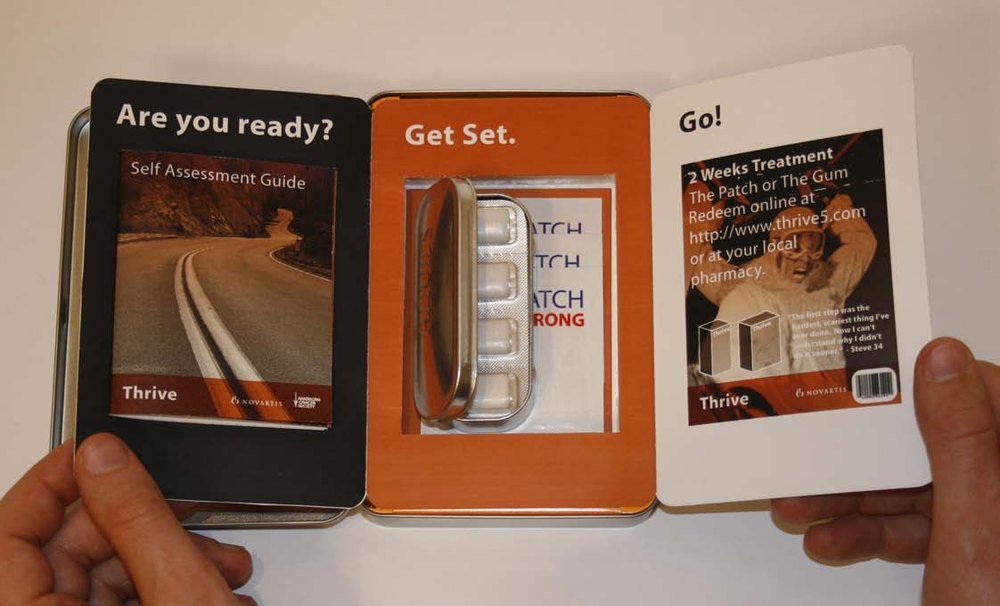
| Starter kit | A three-step kit, “Are you ready? Get set. Go!”, to sample forms of NRT before committing, with versions for couples, gifts and hospital discharge | “Give me someplace to start… I want it to be easy to try.” |
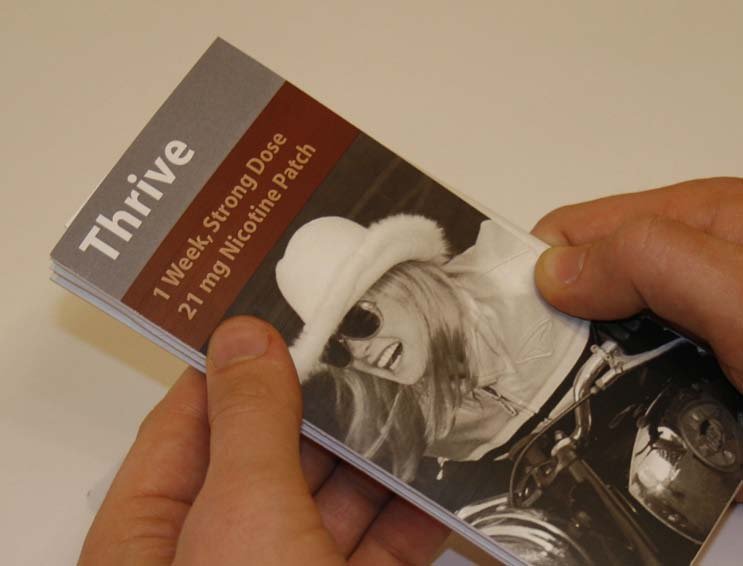
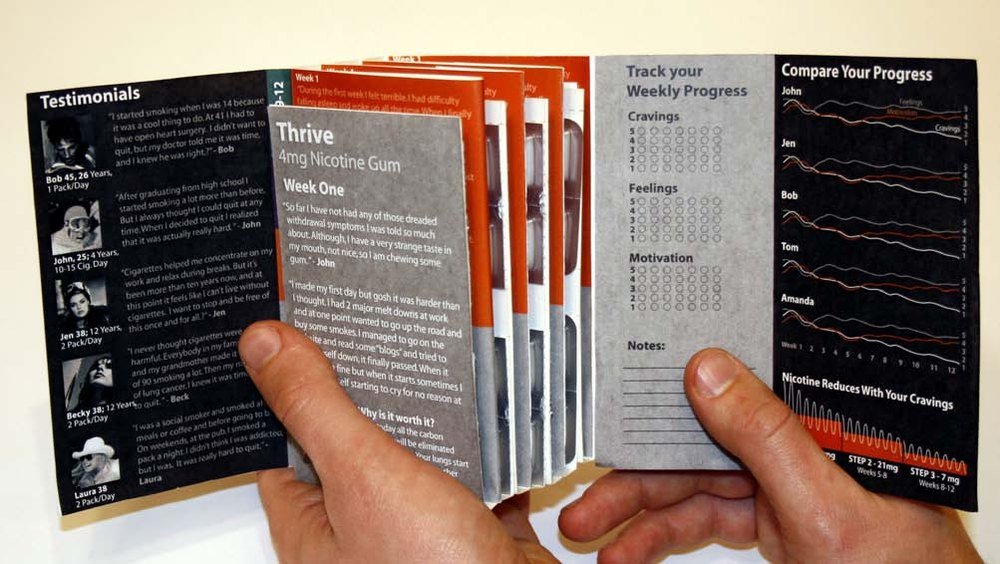
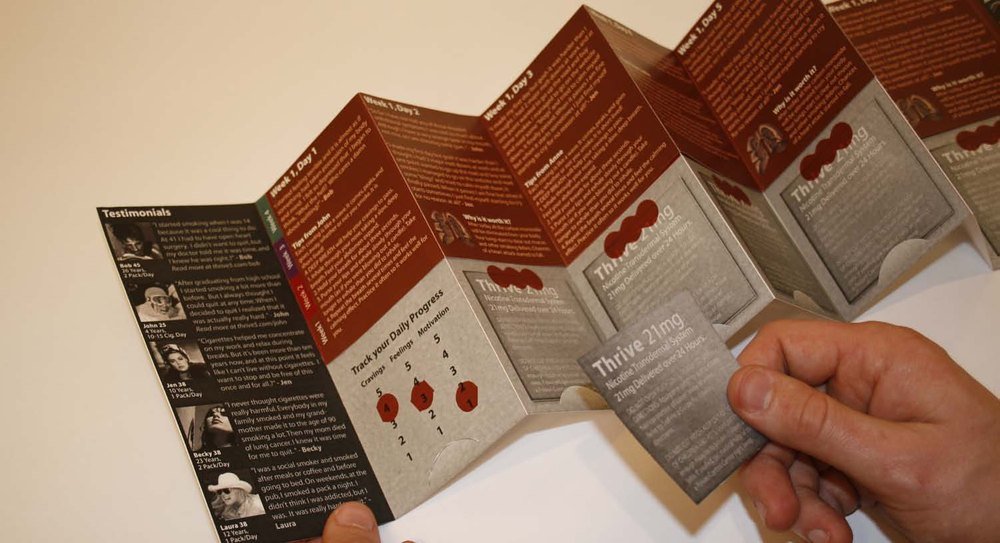
| Mapping the journey | Patch and gum packs organized week by week, with diaries from five ex-smokers, craving trackers and a look at what’s next | “If someone walked me through the first couple weeks, that would make a difference.” |
| Online community | One place for stories, forums, expert advice, self-assessment and products, with smokers’ voices at the center | “I like reading the stories of other smokers, even if I don’t contribute.” |
| Nicotine-free support | Gums, chews, water additives, scents and sleep aids for cravings, stress and weight, during and after NRT | “I don’t want to replace nicotine with nicotine, I want to get off nicotine.” |
Mapping the journey
The most developed concept turned the 12-week course of nicotine patches into a guided journey. Each weekly pack opens like a diary: five ex-smokers share their stories and advice day by day, a health section explains what is happening in the body, and the stickers that hold the next patch double as a 1–5 rating of cravings, feelings and motivation. At the end of each week, people compare their progress with the ex-smokers and see why finishing the full course matters.
This study was done in 2007. Many of the ideas presented were later embraced by the industry, such as quit-smoking apps and online communities, personalized quit plans, and day-by-day progress tracking during nicotine replacement therapy.
Postscript: in 2015, Novartis combined its over-the-counter business with GSK’s consumer health business in a joint venture. GSK bought out Novartis’s share in 2018, and the business became Haleon in 2022.